



You’re in your late 30s or 40s. You’re sharp, accomplished, and used to performing at a high level. But lately, something feels different.
Maybe it’s the sleep. You’re waking at 3am and can’t get back down. Maybe it’s the energy — you used to bounce back from a hard week; now you’re running on fumes by Thursday. Maybe it’s the brain fog, the mood shifts, the way your digestion has changed, or the fact that your body composition is shifting even though nothing else has.
You’ve mentioned it to your doctor. You’ve been told your labs are normal. You’ve been offered birth control, an antidepressant, or a referral to a gastroenterologist.
And you’re still not better.
This is the experience that brings most of my clients to functional medicine. And it’s happening to women across Washington DC — in government, law, healthcare, policy, and every other field where showing up fully is non-negotiable.
Perimenopause Starts Earlier Than Most Women Are Told
One of the most common things I hear is: “I didn’t think I was old enough to be in perimenopause.”
Perimenopause — the hormonal transition leading up to menopause — can begin as early as the mid-30s, and it’s rarely a clean, linear process. A 2025 study from the University of Virginia found that symptoms associated with perimenopause are common in women as young as 30, and that these symptoms are “understudied and often dismissed by physicians.” 1
The transition can last 7 to 10 years. During that time, estrogen and progesterone fluctuate unpredictably. Progesterone often declines first, which can cause sleep disruption, anxiety, and irregular cycles — symptoms that don’t always look like “menopause” to a conventional provider.
This is why so many women spend years cycling through specialists — a cardiologist for palpitations, a gastroenterologist for bloating, a therapist for mood changes — without anyone connecting the dots.
Why Standard Labs Often Miss It
Standard hormone testing in conventional medicine typically includes estradiol and FSH. But these numbers can look completely normal during perimenopause, even when symptoms are significant.
That’s because perimenopause is defined by variability, not consistent decline. Estrogen can spike and crash within the same cycle. A single blood draw captures one moment in time — not the pattern.
Functional medicine takes a more comprehensive approach. This might include:
•Full sex hormone panels — estradiol, estrone, estriol, progesterone, testosterone, DHEA
•Hormone metabolites — how your body is processing and clearing estrogen (relevant for mood, breast tissue health, and inflammation)
•Adrenal function — cortisol rhythm throughout the day, not just a single morning value
•Thyroid — the full panel, including free T3, free T4, reverse T3, and thyroid antibodies
•Inflammatory markers — because chronic inflammation amplifies every perimenopausal symptom
The goal is to understand your hormonal ecosystem, not just check a box.
The Gut-Hormone Connection Most Providers Miss
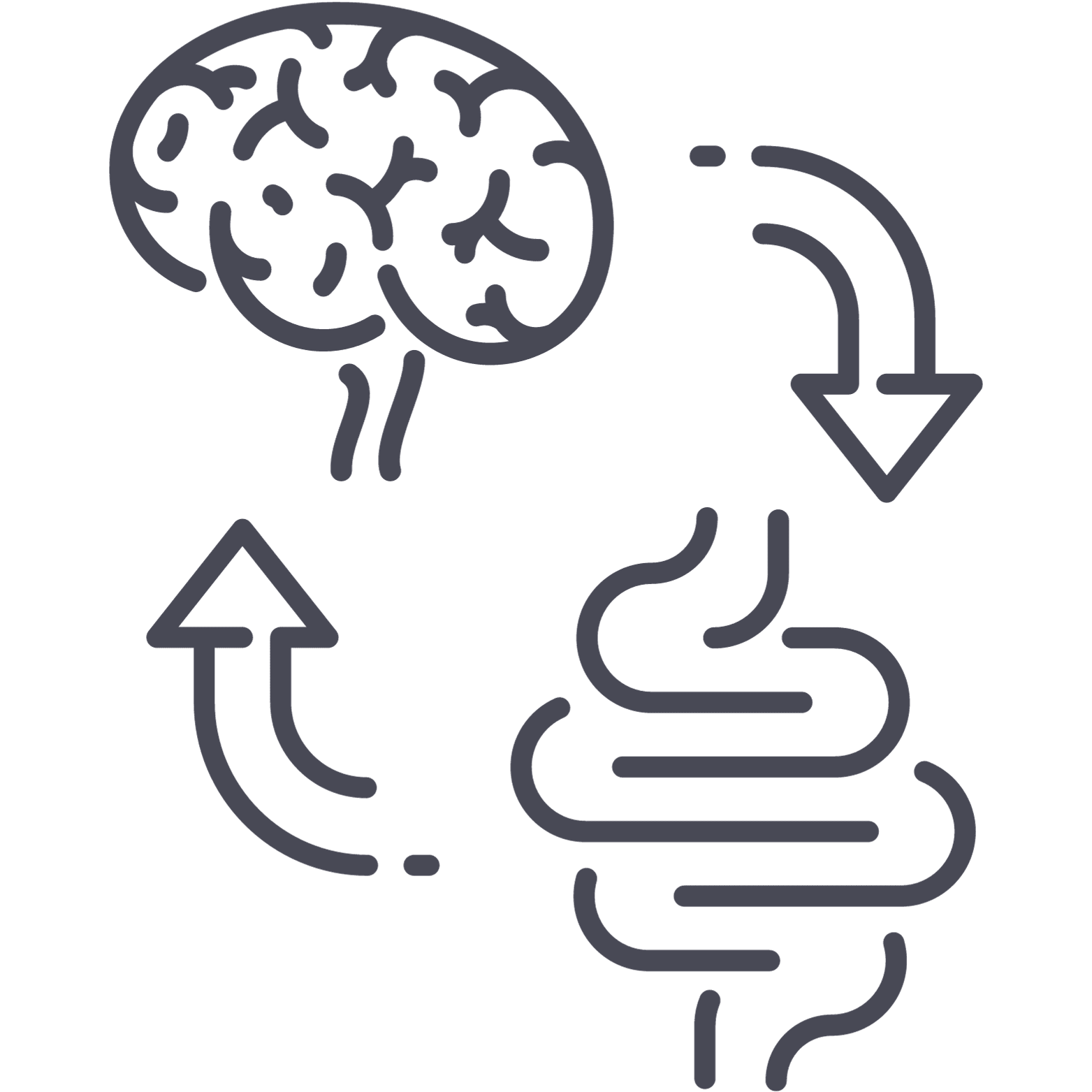
Here’s something that doesn’t come up often in conventional medicine: your gut microbiome directly influences your hormone levels.
A specific collection of gut bacteria — called the estrobolome — produces an enzyme that helps regulate how estrogen is metabolized and recirculated in the body. When the gut microbiome is disrupted (through stress, antibiotics, diet, or infection), estrogen metabolism can become dysregulated. 2
Research published in Nature (2025) found that the gut microbiome significantly contributes to hormone-related changes in women during the menopausal transition. 3 A 2022 study found that gut microbiome composition could predict plasma progesterone levels in pre- and post-menopausal women. 4
This means that if you’re dealing with hormone symptoms and gut symptoms simultaneously — bloating, constipation, irregular digestion alongside mood changes and sleep disruption — they may not be separate problems. They may be the same problem showing up in different places.
Addressing gut health is often a central part of the work we do in functional medicine for perimenopause.
Why DC Women in Particular Are Struggling
Washington DC is not a low-stress environment. The work is high-stakes, the pace is relentless, and the political climate over the past several years has added a layer of ambient stress that is genuinely hard to escape — even for people who are good at managing it.
Chronic stress has a direct impact on hormones. Cortisol, the primary stress hormone, competes with progesterone for the same receptor sites. When cortisol is chronically elevated, progesterone production can be suppressed — which accelerates the symptoms of perimenopause and makes the transition harder. 5
This isn’t about being unable to handle stress. It’s biology. And it’s why the same woman who thrived in her 30s may find herself struggling in her 40s in ways that feel disproportionate to what’s actually happening in her life.
Functional medicine doesn’t pathologize this. It takes it seriously, investigates it, and addresses it.
What the Work Actually Looks Like
At Rise Functional Medicine, the first step is always a Wellness Evaluation — a thorough conversation about your history, your symptoms, and what you’re trying to get back to.
From there, I make a recommendation. For most perimenopausal women, the work involves:
1.Comprehensive testing to understand your hormonal and metabolic baseline
2.Addressing the gut if there’s evidence of dysbiosis, inflammation, or poor estrogen clearance
3.Hormone therapy when appropriate — not as a default, but as a targeted intervention based on your specific picture
4.Lifestyle optimization — sleep, nutrition, movement, and stress regulation, calibrated to where you actually are
5.Ongoing monitoring to adjust as your hormones continue to shift
This is not a protocol. It’s a process, built around your specific physiology.
You Don’t Have to Keep Guessing
If you’ve been told you’re “fine” but you know you’re not, that gap between your experience and your lab results is worth investigating. It doesn’t mean something is wrong with you. It means you need a different kind of evaluation.
Perimenopause is not a disease. It’s a transition. But it doesn’t have to feel like falling apart.
If you’re in the Washington DC area and want to understand what’s actually happening in your body, the first step is a Wellness Evaluation. We’ll start there and figure out the rest together.
About the Author: Ashley is a Doctorate-Prepared Nurse Practitioner and IFMCP-certified functional medicine provider with 10 years of experience working with perimenopausal women and athletes. She practices via telehealth and is licensed in DC, MD, VA, OR, FL, ID, CO, and MA.
References
- Cunningham, A.C., Hewings-Martin, Y., Wickham, A.P. et al. Perimenopause symptoms, severity, and healthcare seeking in women in the US. npj Womens Health 3, 12 (2025). https://doi.org/10.1038/s44294-025-00061-3↩
- Kumari, N., Kumari, R., Dua, A., Singh, M., Kumar, R., Singh, P., Duyar-Ayerdi, S., Pradeep, S., Ojesina, A. I., & Kumar, R. (2024). From Gut to Hormones: Unraveling the Role of Gut Microbiota in (Phyto)Estrogen Modulation in Health and Disease. Molecular nutrition & food research, 68(6), e2300688. https://doi.org/10.1002/mnfr.202300688↩
- Nieto MR, et al. “Menopausal shift on women’s health and microbial niches.” Nature Partner Journals Women’s Health. 2025. https://www.nature.com/articles/s44294-024-00050-y ↩
- Peters BA, et al. “Spotlight on the Gut Microbiome in Menopause: Current Insights.” Nutrients. 2022. https://pmc.ncbi.nlm.nih.gov/articles/PMC9379122/ ↩
- Chrousos GP. “Stress and disorders of the stress system.” Nature Reviews Endocrinology. 2009. https://www.nature.com/articles/nrendo.2009.106 ↩




Comments +