



When most people think about the gut, they think about digestion. But the gastrointestinal system is also the largest endocrine organ in the body. It produces and regulates hormones and neurotransmitters, and it plays a central role in how your body processes and clears the hormones already in circulation.
One of the most important — and least talked about — mechanisms here is the estrobolome: the collection of gut bacteria responsible for metabolizing estrogen.
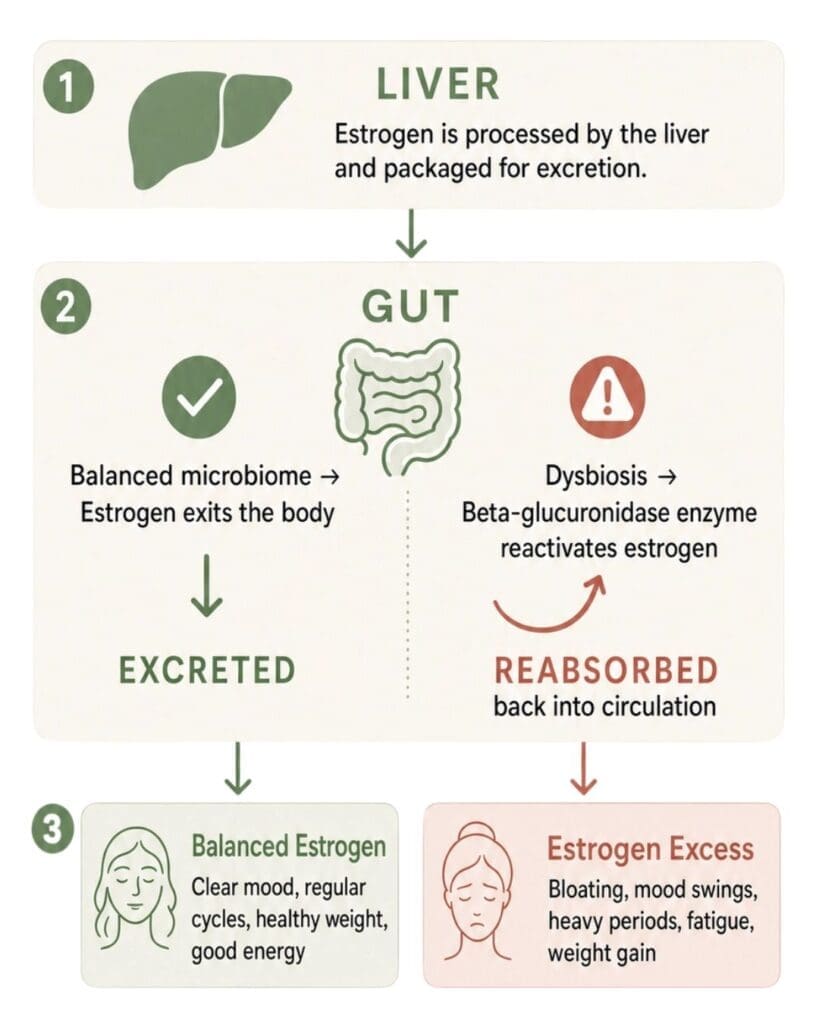
Here’s how it works. Estrogen is processed by the liver, conjugated (essentially packaged for removal), and sent to the gut for excretion. In a healthy gut, most of that estrogen leaves the body. But certain gut bacteria produce an enzyme called beta-glucuronidase, which can deconjugate estrogen — essentially unpacking it and sending it back into circulation.
When gut bacteria are in balance, this process is tightly regulated. When dysbiosis is present — meaning the microbial community is disrupted — beta-glucuronidase activity can increase significantly, causing more estrogen to be reabsorbed rather than excreted.
The result is a pattern that looks like estrogen excess: heavier periods, worsening PMS, breast tenderness, bloating, mood swings, and difficulty losing weight. In men, elevated estrogen from this same mechanism can contribute to fatigue, mood changes, and body composition shifts.
What the Research Shows
A 2025 review in the International Journal of Cancer confirmed that the estrobolome plays a significant role in systemic estrogen levels, with dysbiosis-driven changes in beta-glucuronidase activity directly influencing estrogen-related conditions. [1]
A separate 2025 study found that gut dysbiosis in perimenopausal women was associated with lower estradiol levels and a less favorable metabolic profile — demonstrating that the relationship runs both ways. The gut affects hormones, and hormones affect the gut. [2]
A 2025 Frontiers in Endocrinology review went further, describing the gut microbiota as “an overall regulator of women’s estrogen status during menopause” — and identifying it as an underutilized target for improving hormonal and metabolic health. [3]
This isn’t fringe research. The gut-hormone connection is now well-supported in peer-reviewed literature, and it’s increasingly informing how comprehensive hormone care is practiced.
The Gut Hormone Connection Runs Both Ways
What makes this particularly relevant is that the relationship between gut health and hormones is bidirectional.
Dysbiosis can drive hormonal imbalance. But hormonal changes — particularly the decline of estrogen during perimenopause — can also disrupt the gut microbiome. Estrogen supports microbial diversity, and as levels decline, the gut environment shifts. Beneficial bacteria decrease. Inflammatory species increase. This creates a feedback loop where each system is making the other worse.
This is why treating hormones without addressing the gut — or treating the gut without considering hormones — often produces incomplete results.
The Bowel Motility Factor
One piece of this that doesn’t get enough attention: how often you’re having a bowel movement matters.
Estrogen that has been packaged for excretion needs to leave the body through stool. If transit time is slow — meaning you’re not having regular, complete bowel movements — that estrogen sits in the gut longer, giving beta-glucuronidase more opportunity to reactivate it.
Daily, complete bowel movements are not optional when it comes to hormone balance. They’re part of the clearance pathway. Constipation isn’t just uncomfortable — it’s a hormonal issue.
Restoring the Gut Hormone Connection: What It Actually Takes
Understanding the estrobolome is useful. But understanding it doesn’t change it.
The microbiome is responsive — it shifts based on what you eat, how you sleep, how much stress you’re carrying, what medications you’ve taken, and how you move. That’s actually good news. It means it can be changed. But it takes more than a supplement or a probiotic off the shelf.
When gut and hormone symptoms are showing up together, I look at the full picture — not just what’s happening, but why, and in what order to address it.
That typically includes:
Targeted testing — A comprehensive stool test (GI-MAP) measures beta-glucuronidase activity directly, along with microbial diversity, markers of intestinal permeability, and immune function in the gut. Combined with a comprehensive hormone panel, this pairing tells a much more complete story than either test alone.
Dietary shifts — The microbiome responds quickly to changes in fiber intake, fermented foods, and the removal of foods that drive inflammation. This isn’t about restriction — it’s about feeding the bacteria that support hormone clearance.
Gut repair — In many cases, the gut lining itself needs support before the microbiome can fully stabilize. Leaky gut and dysbiosis often go together, and addressing one without the other produces partial results.
Stress and sleep — Both directly affect the gut-brain axis and the microbial environment. Chronic stress alters gut motility, increases intestinal permeability, and shifts the microbial balance in ways that affect hormone metabolism. This piece is non-negotiable.
Targeted supplementation — Based on what testing reveals, not what’s trending. This might include specific probiotic strains, digestive enzymes, or nutrients that support estrogen metabolism — but only when the foundation is in place.
This is the kind of work that happens inside a structured program, not a single appointment. The goal isn’t to manage symptoms indefinitely — it’s to build a gut environment that supports your hormones consistently, without you having to think about it constantly.
For Athletes
If you’re training consistently and noticing that your recovery is slower, your mood is more volatile around your cycle, or your body composition isn’t responding the way it should — the gut-hormone connection is worth investigating.
High training loads, frequent antibiotic use, and restrictive eating patterns all disrupt the gut microbiome. This can impair estrogen clearance, increase systemic inflammation, and affect how well your body responds to hormonal signals — including the ones that regulate muscle repair, sleep quality, and energy availability.
The Takeaway
Bloating and mood swings aren’t two separate problems. They may be two symptoms of the same underlying disruption.
Understanding the gut hormone connection is the first step. The next is doing something about it.
If your gut symptoms and your hormone symptoms showed up around the same time — or if treating one hasn’t resolved the other — that’s a signal worth paying attention to.
A Wellness Evaluation is where we start. We look at your full history, your symptoms, and what’s actually worth testing — so the approach is targeted, not generic.
References
- Larnder AH, et al. The estrobolome: Estrogen-metabolizing pathways of intestinal bacteria. Int J Cancer. 2025. https://onlinelibrary.wiley.com/doi/full/10.1002/ijc.35427
- Association of Gut Dysbiosis With Hormonal Imbalance in Perimenopausal Women. J Health Women’s Care Res. 2025. https://jhwcr.com/index.php/jhwcr/article/view/1442
- Wang H, et al. Gut microbiota has the potential to improve health of menopausal women. Front Endocrinol. 2025. https://www.frontiersin.org/journals/endocrinology/articles/10.3389/fendo.2025.1562332/full
- Tahri A, et al. Unraveling the links between estrogen and gut microbiota in perimenopause. PMC. 2025. https://pmc.ncbi.nlm.nih.gov/articles/PMC12476589/
- Martínez-Nortes ME, et al. Impact of long-term medication on estrobolome-associated glucuronidase and sulfatase activities. Maturitas. 2026. https://www.sciencedirect.com/science/article/pii/S0378512226000071





Comments +